Quick answer
Fire alarm categories L1 to L5, P1/P2 and M are defined in BS 5839-1, covering everything from full-building detection to targeted risks. The right choice depends on your fire risk assessment.
If your building needs a fire alarm system, you’ll quickly come across the term “fire alarm categories”. These are defined in BS 5839-1, the British Standard for fire detection and alarm systems in commercial premises. Each category sets a different level of life protection based on your building’s fire risk. BS 5839-1 was significantly updated in April 2025, changing how sleeping-risk areas must be protected.
- L1 covers virtually the entire building for maximum protection, while L4 and L5 are far more targeted in scope.
- The correct category is not a guess or a preference: it is determined by your building's use, layout, and fire risk assessment.
- BS 5839-1 was updated in 2025, and sleeping-risk areas now require smoke detection rather than heat detection.
What Are Fire Alarm Categories?
Fire alarm categories tell you two things:
- Where detection devices should be placed in a building
- What level of protection the system is designed to deliver
As explained by the London Fire Brigade, fire alarm categories define which areas of a building a system should cover, while the correct choice depends on the premises, occupancy and fire risk. They are defined under BS 5839-1 and apply to non-domestic premises only. There are three broad types.
Category M systems are manual, using break-glass call points with no automatic detection at all.
Category L systems use automatic detection to protect people’s lives, and they range from L1 (whole-building coverage) through to L5 (localised, risk-specific coverage).
Category P systems focus on protecting property rather than people, with P1 covering the whole building and P2 covering only defined high-risk areas.
Fire Alarm Categories L1 to L5: What Each Level Means
The five L categories are not simply a sliding scale of more detectors equals better. Each one is designed around a specific protection objective, and the right choice depends on your building’s layout, occupant profile, and identified risks. Going straight to L1 without justification is as much a specification error as choosing L4 when your building genuinely needs more coverage.
Category L1: Maximum Life Protection
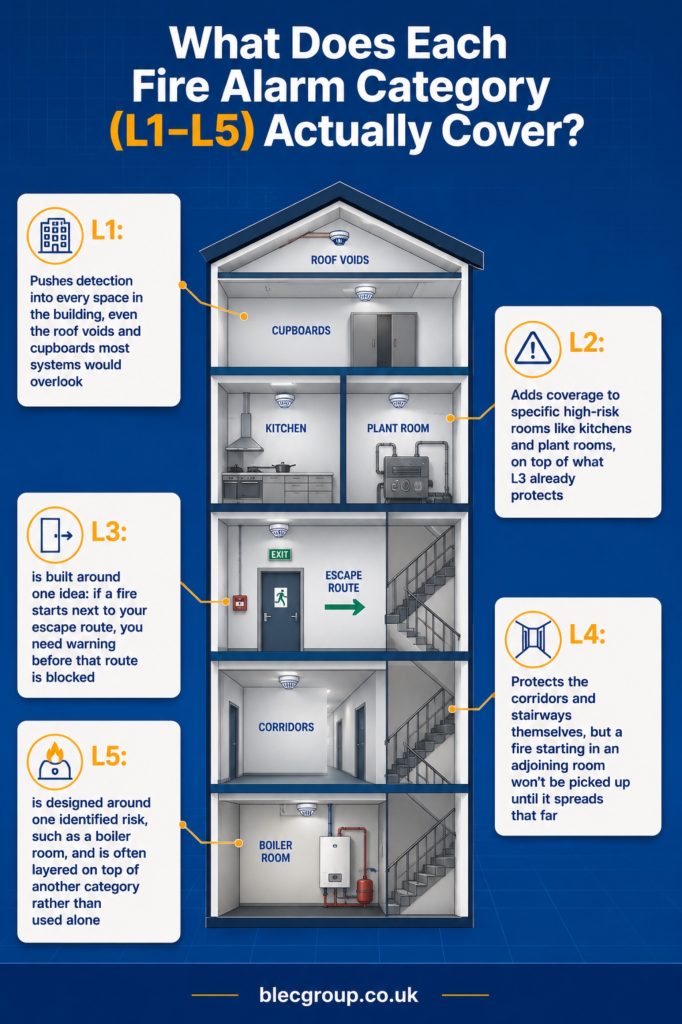
L1 is as comprehensive as it gets. Detection is installed throughout virtually the entire building, including cupboards, roof voids, storage rooms, and any other spaces that might normally be overlooked. The goal is to catch a fire at the earliest possible moment, wherever it starts.
This level is typically used in buildings where people sleep, where occupants may have limited mobility or where the layout is particularly complex. Care homes, certain hotels, and large residential institutions are common examples.
Category L2: Additional Life Protection
L2 builds on L3 by adding detection in specific high-risk rooms, such as kitchens, plant rooms, or storage areas where a fire is more likely to start or could escalate quickly. It covers escape routes, the rooms that open onto them, and those additional identified spaces.
Hotels and larger commercial premises commonly use L2. It is worth noting that the 2025 update to BS 5839-1 has a direct impact on L2 design, particularly where sleeping areas are involved. Those rooms must now have smoke detection rather than heat detection.
Category L3: Standard Life Protection
L3 covers escape routes and all rooms that open directly onto them. The logic is simple. If a fire starts in a room next to a corridor, occupants need warning before it blocks the only escape route.
This is a practical middle ground for many commercial buildings, including offices, shops and HMOs. It provides enough warning time for safe evacuation without requiring detection throughout the entire building.
Category L4: Modest Life Protection
L4 is more focused. Detection is limited to the circulation areas themselves, meaning corridors and stairways but not the rooms leading off them. This suits smaller premises or buildings where the primary concern is keeping escape routes clear.
The trade-off is real though. A fire starting in a room adjacent to a corridor would not be detected until it reached the corridor itself.
Category L5: Localised Life Protection
L5 is purpose-built for a specific, identified risk. It does not follow a standard layout but is instead designed around one particular location where a fire is considered most likely or most dangerous.
A commercial kitchen or boiler room are classic examples. L5 is often used alongside another category to add targeted early warning at a high-risk point that the primary system does not fully address.
How L1 to L5 Fire Alarm Categories Compare
Choosing between categories comes down to balancing how much of the building needs automatic detection and how much life protection that coverage is intended to deliver. More coverage is not always the right answer. What matters is matching the system to the actual risk.
You can see below the main differences between each category, including coverage, protection level and typical uses:
| Category | Coverage | Level of Protection | Typical Buildings | Main Purpose |
|---|---|---|---|---|
| L1 | Whole building, including voids and stores | Maximum | Care homes, hotels, complex/sleeping-risk buildings | Earliest possible warning everywhere |
| L2 | Escape routes + rooms opening onto them + specified high-risk rooms | High | Hotels, larger commercial premises | L3 coverage plus high-risk rooms |
| L3 | Escape routes + rooms opening onto them | Standard | Offices, shops, HMOs | Warn before escape route is blocked |
| L4 | Escape routes (corridors, stairways) only | Modest | Smaller premises, low-risk layouts | Protect the means of escape |
| L5 | Custom, localised area | Risk-specific | Boiler rooms, commercial kitchens | Early warning at a specific identified risk |
Which Fire Alarm Category Does Your Building Need?
The category that applies to your building is not something you can work out from a general list. It depends on who uses the building, how they move through it, where the fire risks are greatest, and what your fire risk assessment concludes. That said, there are well-established patterns for different building types.
Here is a practical guide by building type:
Offices
Schools
Hotels
Hotels almost always require L2. The combination of sleeping guests who may not be familiar with the building and high-risk areas like kitchens means escape route protection alone is not sufficient.
Care Homes
Care homes commonly need L1. Residents may have limited mobility and may be unable to evacuate quickly without assistance. The 2025 update to BS 5839-1 reinforces this by requiring smoke detection in sleeping areas rather than heat detection, which responds more slowly.
HMOs
HMO requirements vary considerably depending on the property’s layout and the conditions attached to its licence. There is no single standard answer. A fire risk assessment is the only reliable way to determine what is needed.
Warehouses
Warehouses generally focus on escape route protection, which points toward L3 or L4. However, if the building stores materials with a high fire load or contains specific hazards, additional localised coverage may be required.
Industrial Premises
Industrial buildings vary enormously. Processes, materials, and hazards all affect what is needed. Many industrial sites end up with a combination of categories, including L5 elements, to cover specific high-risk points within a broader system.
Apartment Blocks
The communal areas of apartment blocks such as corridors, stairwells, and lobbies fall under BS 5839-1 and typically require at least L4 coverage. The detection inside individual flats is a separate matter governed by BS 5839-6.
Retail Premises
Retail buildings generally centre on escape route protection, making L3 or L4 a common starting point. Stock storage areas and plant rooms may warrant additional coverage depending on what the fire risk assessment identifies.
If you are unsure which category applies to your premises, our fire alarm installation service includes a site survey to confirm exactly what your building needs before any work begins.
Who Decides Which Fire Alarm Category Is Required?
Category selection is not a decision an installer makes on the day. It is a structured process involving several parties, and the outcome needs to be confirmed before any system is designed or ordered.
The starting point is always a fire risk assessment, which identifies the hazards in a building, the people at risk, and the level of detection needed to protect them. BS 5839-1 specifically recommends that a system designer confirms the proposed category with the purchaser before an order is placed, to avoid disputes further down the line about what the system was supposed to cover.
Building Regulations and BS 5839-1 itself set the technical framework
while your insurer may add requirements on top of those. The Fire Industry Association recommends that purchasers seek advice from a competent person or their enforcing authority before committing, to make sure the proposed system satisfies both the law and their insurance policy.
Are Fire Alarm Categories a Legal Requirement?
Not directly. UK fire safety law does not specify a particular fire alarm category, but it does require suitable fire precautions based on the risks identified in a fire risk assessment. BS 5839-1 provides the guidance used to select the appropriate category and level of detection for the building.
Fire Safety Order
The Regulatory Reform (Fire Safety) Order 2005 is the main fire safety law in England and Wales. It requires the responsible person to identify fire risks and put suitable fire safety measures in place. This includes ensuring fire detection and alarm systems are suitable for the building and its occupants where required.
Role of the Responsible Person
The Fire Safety Order places legal duties on whoever is identified as the ‘Responsible Person’ usually the building owner, employer, or landlord. That person must carry out and record a fire risk assessment and put in place appropriate fire precautions.
Compliance Responsibilities
Day-to-day compliance is largely managed by the responsible person. However, local fire and rescue authorities carry out risk-based inspections and can issue enforcement notices if they find serious failures. These notices can set out the required corrective actions and deadlines.
Why Professional Fire Alarm Design and Installation Matters
Selecting the right category is only part of the job. A system that is poorly designed or installed by someone who lacks the necessary competence can fail to perform when it counts, regardless of which category it was specified to.
The BAFE SP203-1 certification scheme gives Responsible Persons an independent way to verify that a provider is competent. The scheme is split into four modules covering design, installation, commissioning and maintenance, so a company is only certified for the specific areas in which it has proven competence. Certification is issued by UKAS-accredited bodies including BSI, NICEIC, NSI and SSAIB.
Detector choice also matters far more than many people realise. False alarms from automatic fire detection systems cost UK businesses and fire and rescue authorities an estimated £1bn per year, according to a BRE briefing paper. The Fire and Rescue Service has achieved roughly a one-third reduction in Unwanted Fire Signals in recent years, but NFCC’s reducing false alarms guidance is clear that significant further action is still needed.
Choosing the right detector for each zone is a big part of the solution. Independent multi-sensor detector research from BRE shows that more advanced devices can reduce false alarms. These detectors combine smoke, heat and CO sensors while maintaining fire detection sensitivity.
FAQs
What is the difference between L1 and L2 fire alarms?
L1 covers virtually the entire building, including voids and storage areas. L2 covers escape routes, rooms opening onto them, and additional high-risk rooms such as kitchens or plant rooms, but does not extend to the whole building.
Which fire alarm category is required for an office?
Most offices require L3, covering escape routes and the rooms that open onto them. The specific requirement depends on your fire risk assessment.
Is an L1 fire alarm the highest level of protection?
Yes. L1 provides the widest coverage of all the L categories, with detection throughout virtually the entire building.
What is a Category L5 fire alarm?
L5 is a bespoke, localised system designed to protect a specific area identified as high-risk in a fire risk assessment, such as a boiler room or commercial kitchen. It is often used alongside another category.
Can a fire risk assessment change my fire alarm category?
Yes. If your building’s use, layout, or occupancy changes, a new or reviewed fire risk assessment may result in a different category being recommended.
How often should a fire alarm system be inspected and serviced?
BS 5839-1 recommends a minimum of two service visits per year for most systems. Though some buildings may require more frequent maintenance depending on their use and complexity.
Conclusion
Fire alarm categories L1 to L5 provide different levels of coverage and life protection. The right choice depends on your fire risk assessment, building layout and occupants. Proper design and competent installation are both essential for effective protection.
A professional site survey can help identify the most suitable category for your building and ensure the system meets its specific needs. Get in touch today for a free site survey and a tailored quote from our fire safety specialists.